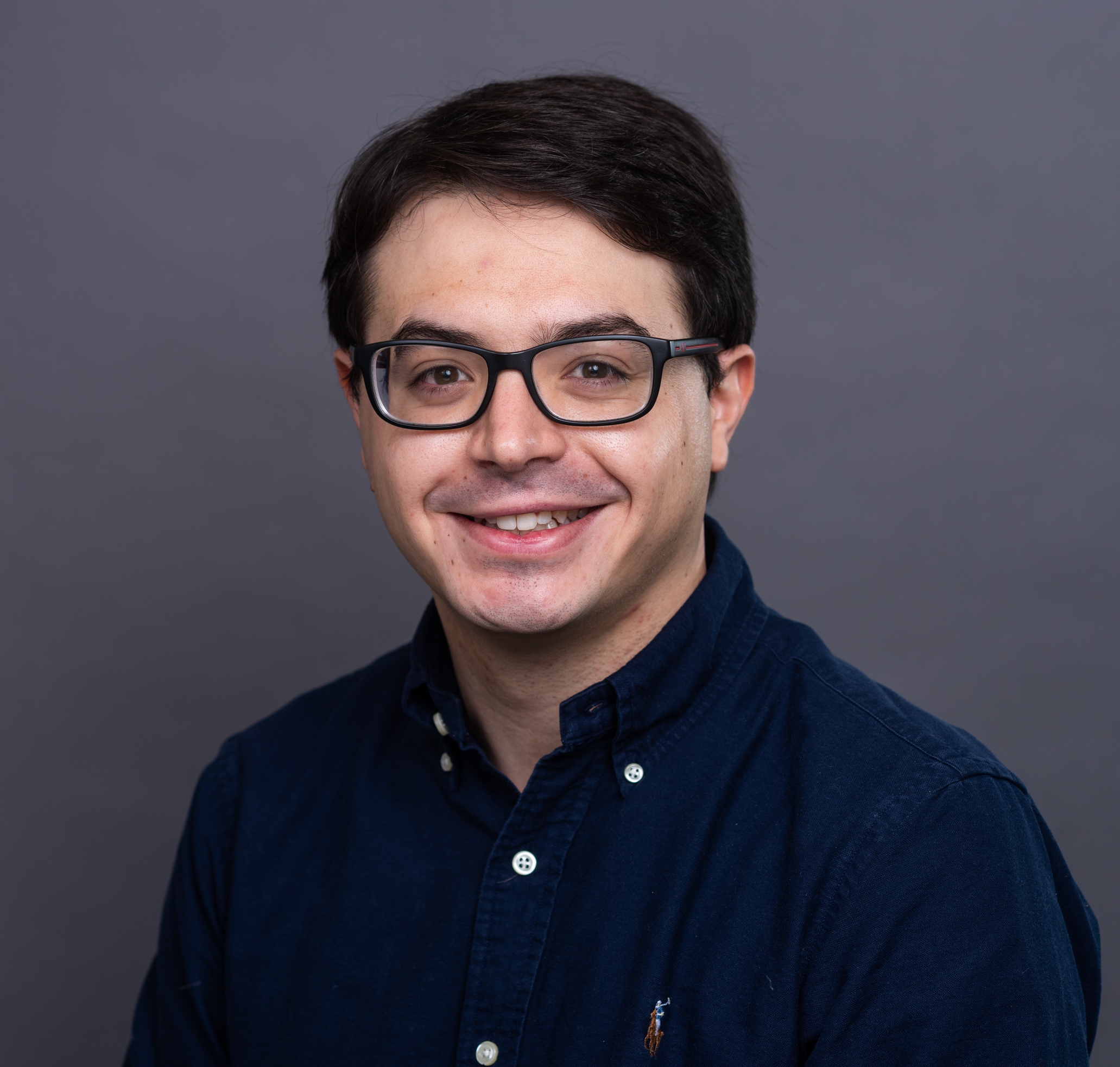
Ricardo Cannizzaro
About
I am a causal AI researcher, machine learning scientist, and engineer with a recently completed PhD from the University of Oxford. I work at the intersection of causal modelling, probabilistic reasoning, and generative AI, with a focus on building systems that can learn, reason, and make decisions under uncertainty in real-world and interactive environments.
I completed my DPhil at the Oxford Robotics Institute within the Cognitive Robotics Group and the Goal-Oriented Long-Lived Systems group, supervised by Prof Lars Kunze and Prof Nick Hawes. My research was funded by the Australian Defence Science and Technology Group, where I previously worked as a Defence Research Scientist on trusted autonomous systems.
During my PhD, I completed two research internships at Microsoft Research (MSR) in Redmond with the AI Interaction and Learning and People-Centric AI groups. My work focused on improving reasoning and consistency in foundation and generative models operating in interactive, causally complex environments. This included research on counterfactual consistency for image generation and parallel-world training frameworks for learning structured game mechanics — not just pixels — resulting in first-author publications and system prototypes.
I have over 10 years’ experience designing and deploying AI/ML systems across robotics and large-scale simulation environments. My work emphasises end-to-end systems — from model development to deployment — with a focus on robustness, interpretability, and alignment with human expectations.
Research Focus
My research explores probabilistic generative causal models for representing structured knowledge and uncertainty, combining domain expertise with data-driven learning. Methodologically, this includes causal representation learning, Bayesian inference, probabilistic programming, and deep generative models such as diffusion models and transformers.
A central focus of my work is learning human-aligned causal representations and developing faithful, counterfactual-based explanations that support understanding and trust by non-technical users. I am particularly interested in AI systems that must behave consistently, robustly, and transparently in real-world settings.
Research Interests: probabilistic generative causal modelling; Bayesian causal inference; causal representation learning; counterfactual reasoning and explanations; probabilistic programming; foundation and generative models; uncertainty-aware decision-making; human-centred AI systems.
Currently Seeking
I am currently seeking Research Scientist, Applied Scientist, and Research Engineer roles in industry (US), focusing on generative AI, causal machine learning, and AI systems that operate reliably under uncertainty in real-world environments.
Contact
To discuss research, collaboration, or opportunities, feel free to reach out to me at ricardo.cannizzaro@gmail.com or via LinkedIn.
Work Experience & Education
Work Experience
Before my DPhil I was working as a Defence Research Scientist in the Aerial Autonomy group of the Australian Defence Science and Technology Group (2017-2021), where my research focused on decentralised teams of autonomous aerial and ground robots for missions in challenging uncertain and complex environments, such as the urban terrain. My research was at the intersection of AI/ML, software and hardware engineering to develop autonomous behaviours, integrate them into hardware, and experimentally validate complete systems through flight trials in real urban environments across Australia, Singapore, Montreal, and New York City.
My AI/ML and robotics research at DSTG has spanned a wide range of topics, including:
- Decentralised task planning in unknown environments with heterogeneous multi-robot systems
- Robotic swarming methods for scalable and adaptive drone data-ferrying
- Adaptive GNSS-SLAM localisation methods for autonomous robot navigation in mixed GNSS-available environments (internal technical report)
- Path- and motion-planning for safe, smooth, and efficient aerial robot navigation (internal technical report)
- Command, Control, Communication, and Computers (C4) architectures for autonomous drone system integration with federated common operating picture software (internal technical report)
- A novel Random-Finite-Set-based SLAM algorithm for aerial robots with scanning and solid-state LIDARS
- An evaluation of LIDAR and X-band radar sensors in a particle-dense environment for resilient drone sensing
- Passive source localisation with a novel particle-filter-based bearings-only tracking algorithm
Education
DPhil (PhD) Engineering Science
Oxford Robotics Institute, University of Oxford
Completed, 2026
Supervisors: Prof Lars Kunze and Prof Nick Hawes
(Cognitive Robotics Group; Goal-Oriented Long-Lived Systems Group)
Funded by the Australian Defence Science and Technology Group
Thesis: Causal Artificial Intelligence for Robust Robot Reasoning under Uncertainty
My doctoral research focused on uncertainty-aware and probabilistic causal modelling for learning, inference, decision-making, and explanation in complex, partially observable environments. A central theme of my work was learning human-aligned causal representations and developing faithful, counterfactual-based explanations to support understanding and trust by non-technical users.
Methodologically, this work combined causal representation learning, Bayesian inference, probabilistic programming, and deep generative models, applied across both interactive virtual environments and real-world, hardware-integrated robotic systems. This research included, and subsequently extended, work completed through two Microsoft Research internships.
Selected Coursework: Oxford Scientific Entrepreneurship Course; Oxford Language Centre Italian Fast-Track Course (Parts 1–2)
Bachelor of Engineering (Honours) (Robotics & Mechatronics) (First Class Honours)
I completed my Bachelor of Engineering (Honours) (Robotics & Mechatronics) (First Class Honours) in 2016 at the Swinburne University of Technology in Melbourne, Australia, School of Engineering (4 years + industry-based learning year at DSTG). For my honours thesis project I created an autonomous ground robot system for remote chemical detection and localisation, under the supervision of Professor Zhenwei Cao and Dr Jennifer Palmer. I implemented a passive chemical-emitter localisation algorithm and integrated a novel bespoke DSTG chemical detection sensor into an autonomous Clearpath Robotics TurtleBot 2 robot system.
Bachelor of Science (Mechanical Systems)
I completed my Bachelor of Science (Mechanical Systems) in 2012 at the University of Melbourne in Melbourne, Australia, Faculty of Engineering and Information Technology / Faculty of Science. I spent 6 months at KTH Stockholm in 2012 as a visiting student at the Division of Robotics, Perception and Learning and Department of Engineering Mechanics (Aerospace Engineering).
News
Recent updates on publications, awards, and academic activities.
- 18/07/2026 — I’m pleased to share that today I attended my graduation ceremony at the University of Oxford, marking the completion of my DPhil in Engineering Science and my doctoral research on Causal Artificial Intelligence for Robust Robot Reasoning under Uncertainty. I’m deeply grateful to my supervisors, Prof Lars Kunze and Prof Nick Hawes, and to the many collaborators and colleagues whose mentorship, support, and friendship made this journey possible.
- 26/06/2026 — I’m thrilled to share that I have joined the core team at an AI Stealth Startup as a Founding Researcher. I’m excited to be part of the founding team on this new adventure, helping build a frontier AI lab from the ground up, and I can’t wait to see what we create together.
- 23/04/2026 — I was thrilled to attend ICLR 2026 in Rio de Janeiro, Brazil, where I presented Multiverse Mechanica: A Testbed for Learning Game Mechanics via Counterfactual Worlds during the poster session. It was a wonderful opportunity to share our work, discuss causal and generative world modelling with researchers from across the community, and reconnect with friends and collaborators.
- 10/03/2026 — I’m delighted to share that I passed my Oxford DPhil viva! My thesis was examined by Prof Stephen Roberts as internal examiner and Prof Karinne Ramirez-Amaro of Chalmers University of Technology as external examiner. I’m very grateful to them for the thoughtful and engaging discussion.
- 25/01/2026 — I’m excited to announce that my collaboration with Microsoft Research has resulted in a paper accepted at ICLR 2026: Multiverse Mechanica: A Testbed for Learning Game Mechanics via Counterfactual Worlds. The work introduces a causal generative modelling framework for learning and intervening on game mechanics, enabling counterfactually consistent parallel-world generation where only causally relevant factors change. [Paper]
- 10/10/2025 — I have submitted my Oxford DPhil (PhD) thesis and am currently awaiting my defence (March 2026).
- 05/09/2025 — I am absolutely delighted to share that our work on causal reasoning for robot manipulation has received the Best Paper Award at the European Conference on Mobile Robots 2025 (ECMR 2025) in Padua, Italy! This recognition means a lot - not just for the paper, but for the broader vision of building trustworthy, explainable, and robust autonomous robot systems. A huge thank you to my brilliant collaborators at the Oxford Robotics Institute, Microsoft Research, and Bristol Robotics Laboratory! [LinkedIn post]🏆🤖🎉
- 15/08/2025 — I was delighted to return to Microsoft Research (Redmond) to complete an advanced PhD Research Internship, where I extended my earlier work on causal and parallel-world consistency by developing mechanics-aware generative modelling frameworks and an instrumented interactive PyGame environment.
- 16/08/2024 — I’m pleased to share that I completed my first PhD Research Internship at Microsoft Research, working with the same team on counterfactual consistency objectives for diffusion-based multi-modal generative models and human-aligned image fine-tuning.
- 15/04/2024 — I’m happy to share our work was published at SEAMS 2024: Aloft: Self-Adaptive Drone Controller Testbed, introducing a testbed for studying self-adaptive control in autonomous aerial systems.
- 02/10/2023 — I’m excited to share our paper was published at IROS 2023: CAR-DESPOT: Causally-Informed Online POMDP Planning for Robots in Confounded Environments, which integrates causal modelling into online planning under uncertainty.
- 10/08/2023 — I am honoured and grateful to have received travel support to attend IROS 2023, supported by the IEEE Robot Learning Technical Committee, IEEE RAS member grants, and St Edmund Hall postgraduate funding.
- 29/05/2023 — I co-organised the Multidisciplinary Approaches to Co-Creating Trustworthy Autonomous Systems (MACTAS) workshop at ICRA 2023, alongside Prof Lars Kunze. The workshop brought together keynote speakers, spotlight talks, and panel discussions to explore multidisciplinary perspectives on trust and trustworthiness in autonomous systems. [Workshop]
- 05/01/2023 — I was honoured to give an invited talk at the IROS 2023 workshop on Causality for Robotics, presenting my work on confounded POMDP robot planning.
- 04/06/2021 — I was honoured to receive the Best Paper Award at the ICRA 2021 workshop on Robot Swarms in the Real World for our work on multi-robot exploration.
- 30/05/2021 — I’m happy to share our paper was published at ICRA 2021: An Upper Confidence Bound for Simultaneous Exploration and Exploitation in Heterogeneous Multi-Robot Systems, addressing scalable exploration–exploitation trade-offs in multi-robot teams.
- 18/01/2021 — I’m excited to announce that I have started my DPhil (PhD) at the Oxford Robotics Institute, University of Oxford, with the Cognitive Robotics Group, supervised by Dr Lars Kunze and co-funded by the Australian Defence Science and Technology Group. My research focuses on probabilistic generative causal models for robust robot reasoning and decision-making under uncertainty.
- 11/11/2019 — I’m pleased to share that our work was published at ACRA 2019, presenting a Random-Finite-Set-based SLAM approach for aerial robots operating with scanning and solid-state LIDARs.
- 28/02/2019 — I’m happy to share that our paper was published at AIAC 2019, presenting an experimental evaluation of LIDAR and X-band radar sensing in particle-dense environments.
- 25/05/2018 — I’m excited to share our paper was published at ICRA 2018, presenting scalable swarming and data-ferrying strategies for unmanned aerial systems.